PharmD paths: Specialty hospital pharmacy with Dr. Victoria Williams ’19 ’15
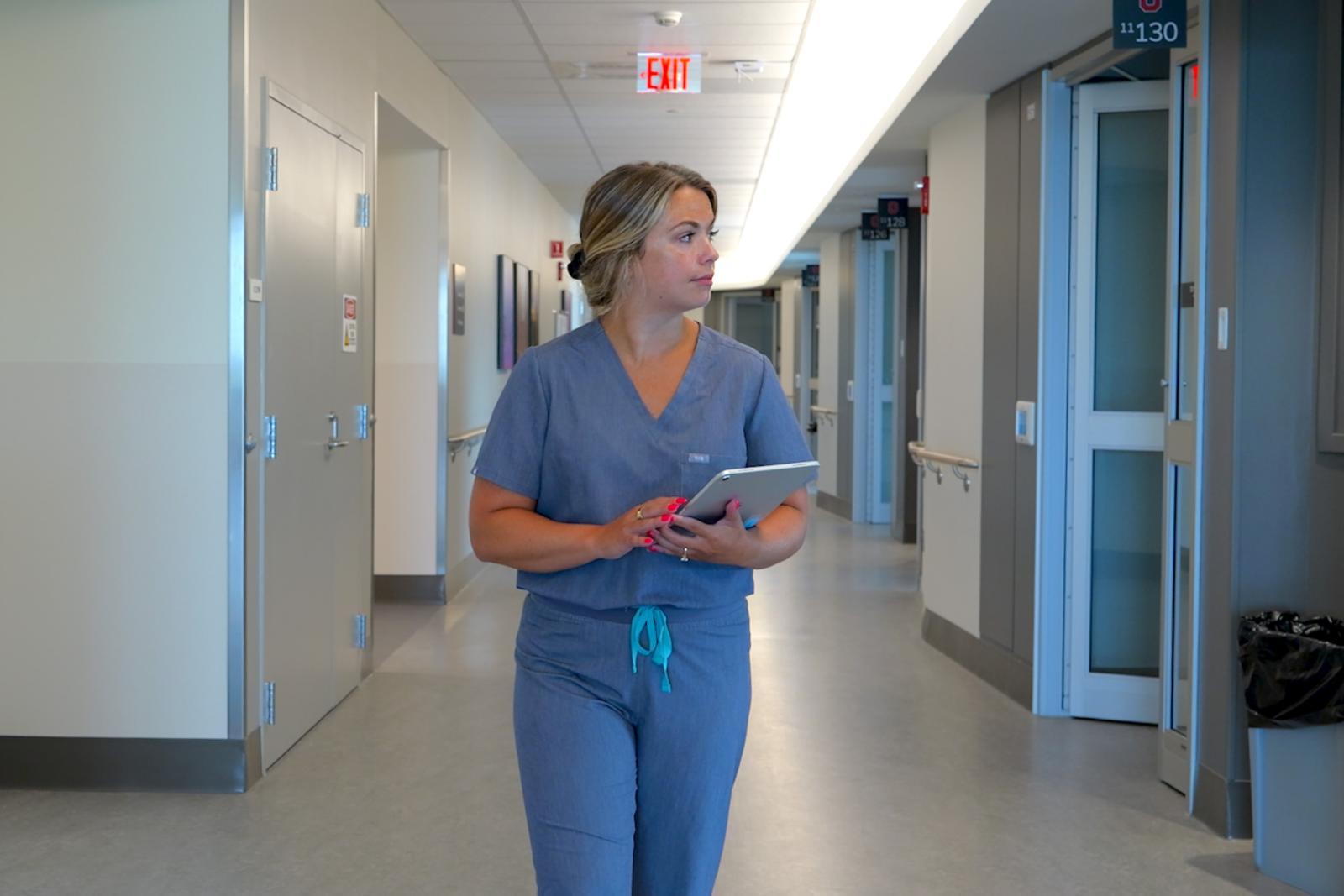
Hospital pharmacists play a crucial role in delivering treatment to patients while they are acutely ill. Specialty pharmacists in the hospital setting see patients alongside the rest of the care team, serving as the medical expert as the interprofessional group designs a care plan.
Specialties may range from pediatrics to cardiology, and specialty pharmacists are responsible for functioning as the medication expert within their given focus. They’ll weigh in on critical medical decisions, teach patients about adherence upon discharge and advance the level of care.
As a specialty pharmacist and assistant clinical professor, Victoria Williams, PharmD ’19, BSPS ’15, splits her time between classrooms at The Ohio State University College of Pharmacy and an intensive care unit (ICU) at the Ohio State Wexner Medical Center (OSUWMC).
Dr. Williams breaks down the field of hospital pharmacy and shares how her passion for patient care motivates her to devote time to advancing therapies through clinical, research and classroom spaces.
What pharmacy positions exist within hospital settings?
I like to think of hospital pharmacy as being divided into two areas, one being our pharmacy teams who are centralized within the walls of the pharmacy itself and two being the specialty pharmacists who are on the floor interacting with patients in their area of expertise.
That first group is filling medication orders by bottling meds, compounding, creating chemotherapy in our nuclear pharmacy and managing the flow of medications throughout the entire hospital. A lot of their responsibilities aligns with the kind of work you see happening in community pharmacies, just with some different classes of medications. They are what keeps us functioning and able to provide essentials like IVs or pain medication to patients.
I fall into group two, so you can find me working in an ICU, where I specialize in patients with acute kidney injury (AKI). Specialty pharmacists like me can range in discipline, from pediatrics to cardiology. We act as medication experts on our care teams, so we weigh in on patients’ treatment plans and help to educate our patients throughout their treatment and discharge.
What does a typical day look like?
What I love about my day-to-day is that there is generally a consistent structure, but anything can happen.
I typically come in around 7 a.m., log into my computer at my desk and start reviewing patients' electronic medical records. I'm looking at their labs, vital signs, medication list and how their different organs are functioning, and I'm making sure that the plan we have in place for them is completely optimized.
A couple of hours into my day, I'll meet up with the larger interdisciplinary team that's made up of my physician colleagues, bedside nurses, respiratory therapists and medical dieticians. We all get together and do what's called multidisciplinary rounds. These are when we work together in a very collaborative way to come up with a care plan for the day.
Rounds will usually take us until about lunch, and then my afternoons are filled with following up on different patient care things like responding to patients’ vitals or a drug information question. I might also have some meetings, do some research, or educate pharmacy students or medical residents. It all depends on what the day has in store.
What’s unique about hospital pharmacy?
While core job responsibilities are quite similar between hospital pharmacy and traditional community settings, in that dispensing and counseling are in the hands of the pharmacist, the relationship you have with patients takes a different shape.
When patients are in the ICU with me, I see them multiple times a day and check on the success of their treatment regularly. But once their time at the ICU is up, our relationship typically ends, whereas community pharmacists may see patients every month. The intensity of our time together may be greater, but it's usually much shorter.
Additionally, as a hospital pharmacist, you’re typically getting a lot more interprofessional interaction out of your day. Within my home ICU, myself, nurses, physicians and everyone else on the patient care team are weighing in. I get the chance to engage in some healthy academic debates about the best path forward for patients and exercise my expertise as the medication pro. I also learn a lot because of these team decisions that we’re making.
How do you see your impact on patients?
We’re really lucky in hospital pharmacy because we see the immediate impact of our actions on patients. I can determine the best treatment plan for a patient, implement it and then circle back later that day to see if it’s working for them. That rapid feedback is so rewarding to me.
Whenever I have the time and resources, I also pursue lines of research that support improving therapies for my patient population. As someone in nephrology, I’ve gotten to launch studies that characterize disease states and symptoms of our patients with AKI, as well as investigate potential therapies to treat their symptoms. The one-on-one interaction I get throughout my day is fantastic, but it’s also exciting to contribute to research that presents potential macro changes.
What training did you go through to get to this position?
For anyone interested in a specialist position like mine, you need to earn a Doctor of Pharmacy degree, and depending on where you go for that PharmD, you’ll likely have some undergraduate prerequisite coursework that will be required. It’s also recommended that you pursue some residency training before these hospital pharmacy positions, since they provide you with some additional, focused real-world education on how to be the best pharmacist you can be in this setting.
I completed my Bachelor of Science in Pharmaceutical Sciences (BSPS) and Doctor of Pharmacy degrees at the Ohio State College of Pharmacy. I then completed two years of residency at OSUWMC through the critical care residency program.
What might make someone a good fit for hospital pharmacy?
Anyone who enjoys a level of unpredictability and variety in their work would enjoy hospital pharmacy. Every day, I have the chance to problem-solve, learn something new and act quickly, all while using my drug information resources and clinical knowledge.
Another aspect of hospital pharmacy that a lot of folks enjoy is the amount of resources at your disposal. With a patient’s full medical history on hand, you have all the pieces of the puzzle before you make a treatment decision. It’s a luxury to have this extra patient care information and have direct interaction with the patient and their loved ones.
How can someone test if hospital pharmacy is a fit?
First, I would recommend looking at your institution's course catalog. If there are any introduction to pharmacy courses or career exploration options for you, definitely register for that. Another way you can get more real experience would be to pursue a role as a pharmacy technician and then apply for a position at a hospital nearby.
Finally, use that network! I began pursuing pharmacy in high school by shadowing a friend of my English teacher who worked at the hospital in town. Your connections can work for you in the most unexpected ways, and it never hurts to make your interests and intentions known.
How did the College of Pharmacy prepare you for your current role?
My interest in hospital pharmacy was sparked by that high school shadowing experience and my first introductory pharmacy courses in the BSPS program. That first intro course opened my eyes to all of the different areas of pharmacy out there. The further I got into my coursework, the more opportunities I had to engage with experiential learning inside the classroom and on rotations.
Once I reached the PharmD program, the clinical rotations were the icing on the cake to all of the classroom training I completed at the college. What I found to be the most helpful was how we learned content in class, put it into practice in lab and then actually used the concepts on IPPE and APPE rotations. It is such a wonderful experience to turn hypothetical patient care knowledge into concrete experience with the guidance of experienced pharmacists.
It feels very full circle to now work as faculty at the college and a preceptor at the med center. The level of patient care that we execute at Ohio State is cutting edge, so I’m excited for our current students to learn in such an exciting space.