Playing the long game: How the Mitton-Fry Lab is advancing treatment of multidrug-resistant infections
This article was published in The Script Magazine – Autumn 2025.
Antimicrobial resistance (AMR) is a major cause of mortality around the world. AMR makes fighting infections increasingly difficult, and essential procedures become significantly riskier as cornerstone antibacterial treatments lose their efficacy.
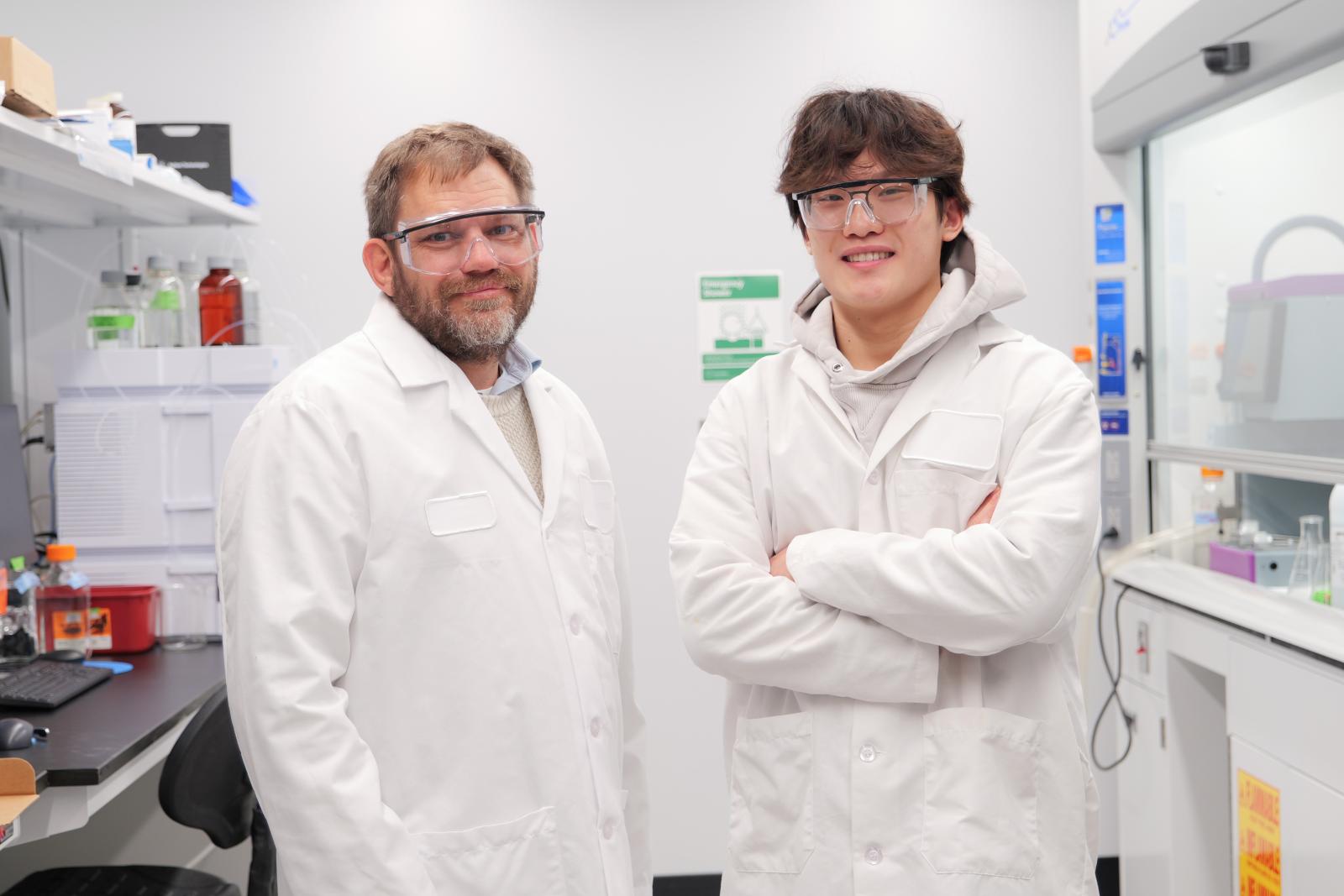
For the past 20 years, Mark Mitton-Fry, PhD, associate professor at The Ohio State University College of Pharmacy has worked in industry and academia to combat AMR. His research team at the college is devoted to discovering Novel Bacterial Topoisomerase Inhibitor (NBTI) compounds to treat resistant infections with an emphasis on Methicillin-resistant Staphylococcus aureus (MRSA).
These NBTI compounds are uniquely suited to overcome drug resistance due to their distinctive method of binding to bacterial enzymes present in AMR pathogens. By utilizing a novel binding mechanism, NBTI therapies can overcome bacterial resistance to the marketed fluoroquinolone antibacterials, which target the same enzymes.
“There’s a clear impact that our work can make if we can improve the medical treatment of these resistant infections,” Dr. Mitton-Fry said. “I’m motivated by the scale of this problem, and I’m truly fascinated by the resistant pathogens we’re focusing on.”
The long-term nature of this NBTI project is an important teaching tool for Dr. Mitton-Fry as he mentors the next generation of researchers.
“The reality of drug development is that impactful projects will take time and money,” he emphasized. “Students in my lab see a large number of grants that they must acquire and apply for to continue this single research effort.”
Most recently, Dr. Mitton-Fry's lab received a 2024 Falk Medical Research Trust Catalyst Award from the Dr. Ralph and Marian Falk Medical Research Trust for their ongoing NBTI project, “Preclinical Development of OSUAB-0284: A new therapy for MRSA infections.” Dr. Mitton-Fry was the first person at Ohio State to receive a Falk Transformational Award for his 2019 project, “Combating Antibiotic Resistance with Novel Bacterial Topoisomerase Inhibitors.”
During his tenure as principal investigator, Dr. Mitton-Fry has accumulated over $3 million of grant funding for his lab and $7 million of external funding for a host of collaborative projects, including an R01 Award from the National Institutes of Health.
“Since my lab was established in 2016, we’ve made a lot of progress on the NBTI project and class of drugs thanks to the hard work in the lab and continued support,” Dr. Mitton-Fry noted. “Initially, we began with a hypothesis about what molecular changes to the inhibitors would improve their safety and prevent increased AMR. Today, we have a compound that offers hope for effective and safe therapy. Slowly, we’re making our way toward clinical trials and getting these treatments into the hands of patients.”
Through nine years of industry experience at Pharmacia and Pfizer, Dr. Mitton-Fry developed a pragmatism that keeps him motivated in this long fight against AMR. His work has resulted in inventorship on eight issued US patents.
“My industry experience helped me to develop a sense of how my work fits into the larger blueprint of medicine,” Dr. Mitton-Fry said. “While I worked at Pfizer, seeing my research move toward patients was extremely motivating, but it also taught me how important focusing on timelines and deliverables is to getting compounds out of the lab and into action.”
In a lab kept running by students and postdocs who are often industry hopefuls, he’s proud to offer them a safe space to foster their knowledge and see the inner workings of drug development.
“When I got my start as a synthetic organic chemist in graduate school, learning to develop molecules was interesting but never connected to a larger purpose for me,” he recalled. “It was only when I reached industry that my skills fell into place in the design and synthesis of new medicines. I want my lab members see their work’s impact now.”
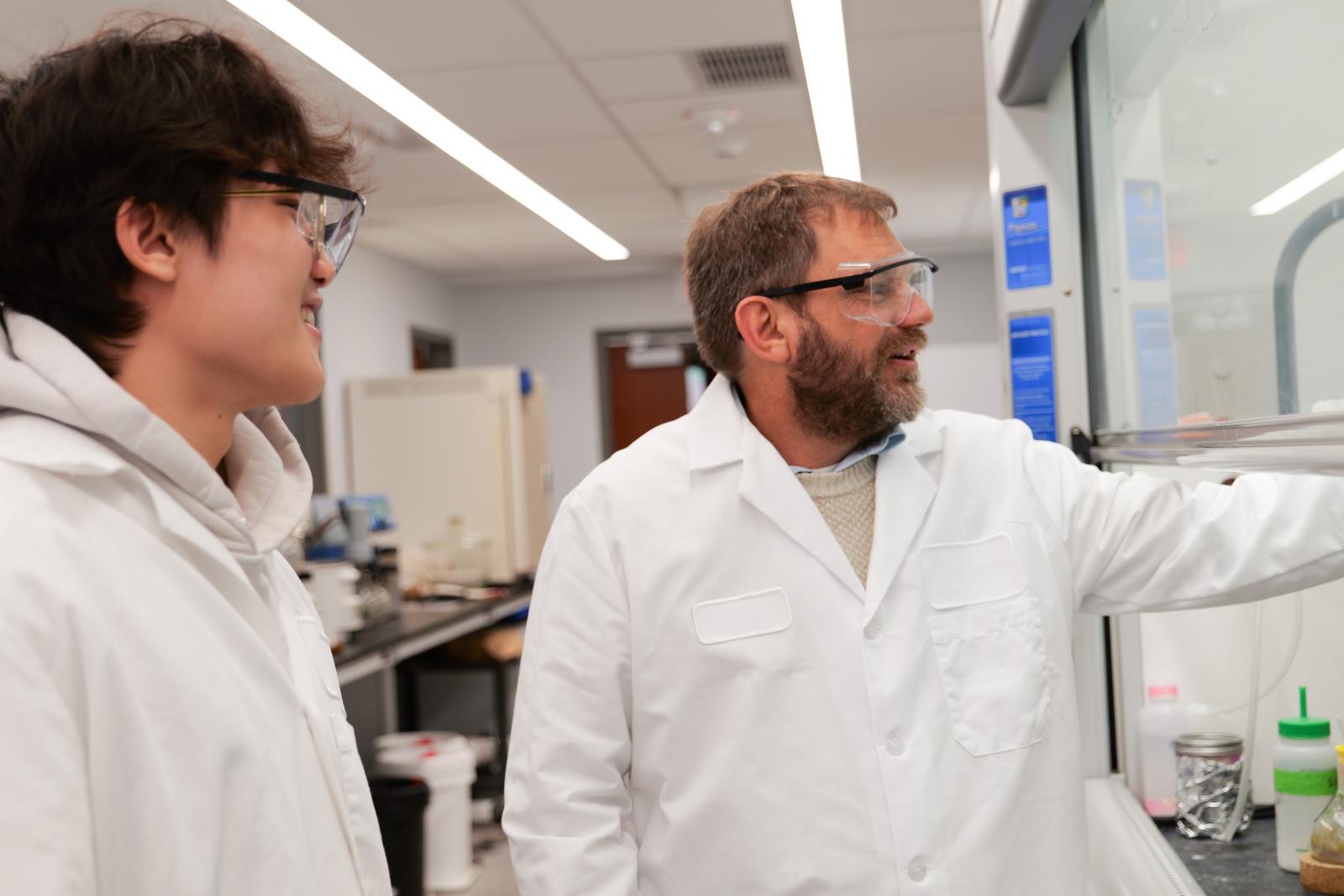
Dr. Mitton-Fry's team of researchers are trained as synthetic chemists, running chemical reactions, isolating reaction products, purifying products and characterizing them. Their work supports the lab’s current AMR drug development goals and exciting interdisciplinary collaborations across the College and University.
By pursuing a concrete and continuous goal in his lab, Dr. Mitton-Fry makes sure that the significance of his students’ work is not lost to abstraction.
“Trying to get all of the properties you need for a drug into one molecule is a nearly impossible task,” Dr. Mitton-Fry said. “It requires a lot of luck, as well as careful thought. That challenge is so motivating, and it’s immensely satisfying to see how much we've accomplished to find this one molecule that we’re developing.”